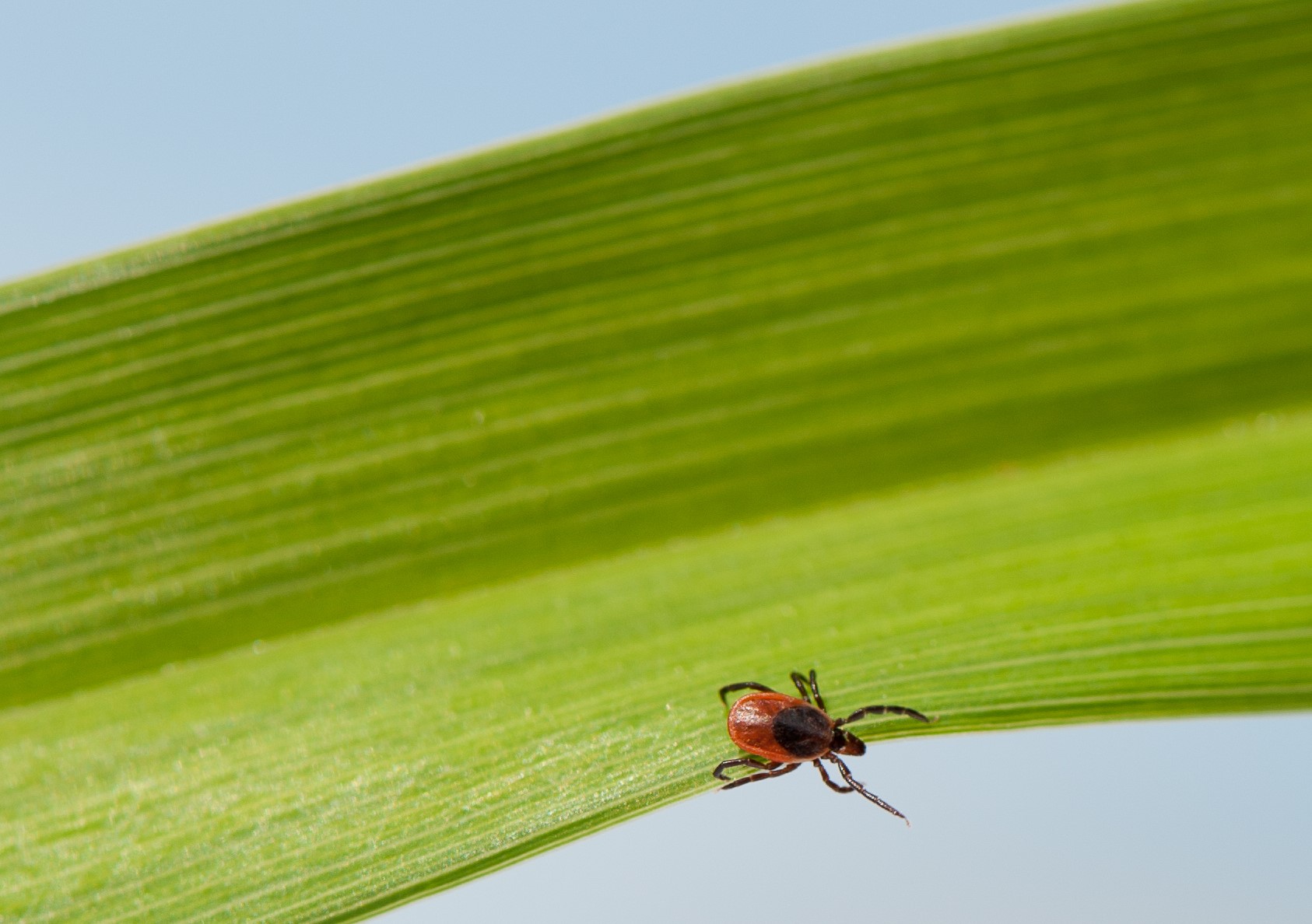
If you were a tick, what tick would you be?
Already know your nymphs from your adults? Can you spot a tick’s favourite hangout? Then this one’s for you.
Yes, ticks are creepy. But they’re also undeniably fascinating.
From stealthy strategists to bold biters and self-made swarms, each species has its own quirks – and so do you.
Are you a Blacklegged Strategist or more of a Lone Star Rebel? Could you be a West Coast Minimalist, a Mountain Veteran, or even… a Self-Sufficient Army?
Answer five quick questions to discover your tick alter ego – and learn a little along the way.
It’s weirdly fun. Slightly unsettling. And perfect for tick enthusiasts.
Note: This quiz assumes you already have some tick knowledge. If you’re new to ticks, take a moment to explore the tick resources on our website first.
The quiz starts here: record the number of responses for each letter and scroll down to find out which tick you would be!
Q1: What is your ideal weekend plan?
A. Quietly waiting in a forest, just observing the world.
B. Chilling out near some lizards in a peaceful oak woodland.
C. Toughing it out on a dry hike – I like it rugged.
D. Running through tall grass to chase down some excitement.
E. Gathering my crew and swarming the nearest hot spot.
F. Enjoying a sunny walk under an open sky through fields, scrubland, or even sidewalks.
Q2: How do you find your people (or prey)?
A. I wait patiently and elegantly and let them come to me.
B. I wait quietly but in strategic places – I know where to be.
C. I climb high and wait patiently – hard work pays off.
D. I run at them. No hesitation.
E. In my youth, I would often hang out in a group.
F. I lie low around grassy edges and footpaths.
Q3: How would your friends describe you?
A. Calm, clever, and dangerous when underestimated.
B. Chill and subtle, but not to be ignored.
C. Tough, outdoorsy, and no-nonsense.
D. Intense, persistent, and maybe a little scary.
E. Unstoppable, mysterious, and surprisingly self-sufficient.
F. Familiar, adaptable, and always around when the weather gets warm. Classic, but don’t underestimate me.
Q4: Which of the following meals sound the most appealing?
A. A nice white-footed mouse or deer.
B. Lizards, birds, and the occasional deer – I like variety.
C. Deer, elk – the big stuff.
D. Humans, dogs, deer… I’m not picky.
E. Livestock, but I’m flexible and will feed on anything really.
F. Small mammals, dogs, and wildlife are my go-tos – but I’ll bite a human if they wander by.
Q5: If you were a villain, how dangerous would you be?
A. Silent but deadly. I carry a lot.
B. I’ve got some tricks, but I’m more low-key.
C. I’m dangerous in the right environment.
D. Very – people should watch out.
E. Still under the radar… but you should keep an eye on me.
F. Subtle but potentially dangerous. I blend right in.
Results: which tick are you?
Mostly A’s: Ixodes scapularis – The Blacklegged Strategist
- Where: Mostly in Eastern and central North America, including parts of Manitoba, Ontario, Québec, New Brunswick, PEI, Nova Scotia, Newfoundland, and occasionally, in Alberta and Saskatchewan. Click HERE to see where these ticks submitted to eTick have been reported from.
- This tick can carry microbes which cause: Lyme disease, anaplasmosis, babesiosis, and Powassan virus disease, among others.
- Feeding preferences: Feeds slowly (3-10 days) on a variety of mammals including mice, dogs, deer, and people. Bites on humans are usually painless and often go unnoticed.
- Did you know? Also known as the Eastern blacklegged tick, this tick is the primary vector of Lyme disease in eastern Canada and North America. Its stealthy approach and ability to produce anaesthetic-like substances make it hard to detect until it’s already feeding.
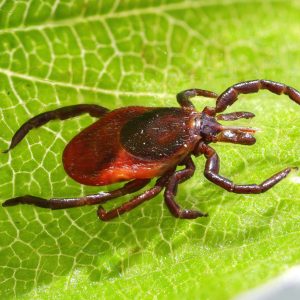
Mostly B’s: Ixodes pacificus – The West Coast Minimalist
- Where: West Coast of North America – especially coastal BC and down through California. Click HERE to see where these ticks submitted to eTick have been reported from.
- This tick can carry microbes which cause: Lyme disease and anaplasmosis.
- Feeding preferences: Feeds over 5-11 days. Prefers reptiles and birds, which are poor reservoirs of the Lyme disease bacteria – keeping human cases lower.
- Did you know? Also known as the Western blacklegged tick, it is much less aggressive than its eastern cousin.
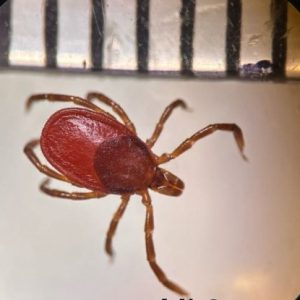
Mostly C’s: Dermacentor andersoni – The Mountain Veteran
- Where: Western North America, including BC, Alberta, and into the Rocky Mountains. Click HERE to see where all Dermacentor ticks submitted to eTick have been reported from.
- This tick can carry microbes which cause: Rocky Mountain spotted fever, Colorado tick fever, and tularemia.
- Feeding preferences: Feeds over 1-14 days, depending on life stage. Prefers large mammals and humans.
- Interesting fact: Known as the Rocky Mountain wood tick, it’s hardy and adapted to dry, elevated terrain. Some adult females produce a salivary neurotoxin which can cause tick paralysis in pets, livestock, and humans (rapid removal leads to rapid recovery).
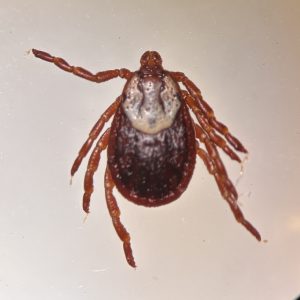
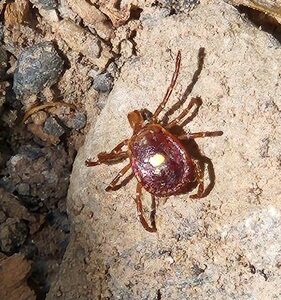
Mostly D’s: Amblyomma americanum – The Lone Star Rebel
- Where: Southeastern and central USA; may be expanding into southern Ontario and Québec with warming climate. Click HERE to see where these ticks submitted to eTick have been reported from. A. americanum found in Canada were most likely brought in by migrating birds.
- This tick can carry microbes which cause: Ehrlichiosis, tularemia, STARI (Southern tick-associated rash illness), Heartland virus, and Bourbon virus.
- Feeding preferences: Very aggressive and will actively pursue hosts. Feeds over 3–8 days and is not picky.
- Interesting fact: Called the Lone Star tick due to the distinctive white spot or ‘lone star’ on the back of adult females, a bite from this tick can trigger alpha-gal syndrome – an allergy to red meat. You don’t want this one at your picnic.
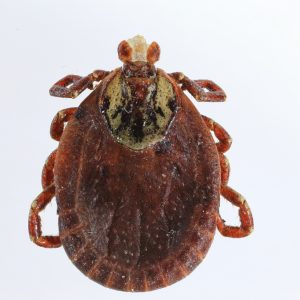
Mostly E’s: Haemaphysalis longicornis – The Self-Sufficient Army
- Where: Native to Asia; invasive in parts of the U.S. (eastern seaboard). Not yet established in Canada but its range in expanding northwards in the United States.
- Impact of this tick: This tick is known to carry microbes which cause theileriosis in livestock. Furthermore, it is a serious biting pest of livestock and can cause anemia, weakness, weight loss, and death. Currently, it is not known to carry microbes which cause human disease in the North American context, however in other global regions, it is known to carry the virus causing severe fever with thrombocytopenia syndrome (SFTS).
- Feeding preferences: Feeds over a period of 3-14 days, often in large groups. Prefers to feed on livestock but will also bite other animals and humans. The larvae can often be found in clusters on the tips of vegetation, waiting for an animal to brush by.
- Did you know? Known as the Asian longhorned tick, a female adult can produce thousands of offspring without a male (parthenogenetic reproduction), as well as by sexual reproduction. They do, however, still require an animal host for blood meals. It is a rising concern for livestock health and hard to control once established.
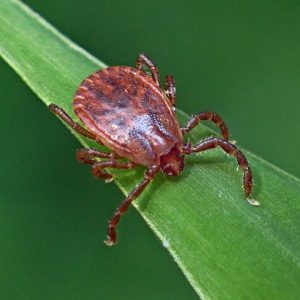
Mostly F’s: Dermacentor variabilis – The Sturdy Classic
- Where: Found from eastern Alberta though to Nova Scotia (primarily in southern regions of the provinces). Click HERE to see where all Dermacentor ticks submitted to eTick have been reported from.
- This tick can carry microbes which cause: Tularemia and Rocky Mountain Spotted Fever (both rare in Canada) in people; Rocky Mountain Spotted Fever, canine monocytic ehrlichiosis in dogs; and Anaplasma marginale in livestock.
- Feeding preferences: Feeds on small mammals, medium-large mammals (e.g., dogs, deer, elk, horses, cattle, sheep) and humans. Feeds over 2-21 days, depending on life stage.
- Did you know? Also known as the American dog tick or wood tick, this species is commonly encountered by people in many regions of central and eastern Canada. Despite its name, it doesn’t depend on dogs to feed or survive and can in fact survive for up to two years without feeding.
We hope you enjoyed this activity!
Whether you are a West Coast Minimalist or a Self-Sufficient Army, one thing’s for sure – ticks are small, but their impact can be big.
Now that you know your tick alter ego, take a few minutes to protect yourself, others, and your pets.
🧢🧴👖 Learn more about ticks, how to prevent tick bites, and how to stay tick-smart outdoors:
👉 Explore TickTOOL
🔍🌿🧭 For even more information about ticks in Canada:
👉 Visit the Government of Canada website
Stay curious. Stay protected. And don’t forget your tick checks!
Cover photo by Catherine Bouchard, PHAC